Holder value vs cost basis
What current holders' tokens are worth against what those holders paid for them. The gap is their unrealised profit or loss.
Holder value. What DEGEN's current holders' tokens are worth at each day's price: $15.6M on 24 Oct.
The real card
Holder value vs cost basis, live on DEGEN. Switch to any cached token.
Holder value vs cost basis
Put this card on a dashboard of your own, or get told when the figure moves
What it is
Two numbers per day, for the whole holder base at once. Holder value is what the tokens current holders own are worth at that day's price. Cost basis, also called realized cap, is what those same holders paid for them in total.
When holder value is above cost basis, holders as a group sit on an unrealised profit; below it, on an unrealised loss.
The space between the two lines is that position, in dollars.
Tokens held on centralized exchanges count in both, because they are investor money even though an exchange's wallet is not a holder; infrastructure wallets don't.
Why compare the two: price is set by the last trades, while cost basis is anchored to what every current holder actually paid, so it moves more slowly and says where the holder base stands.
A token crossing back over its cost basis (Reclaimed cost basis) or falling under it (Lost cost basis) is a signal on Blocktronics, written in plain English with the day it happened.
What goes into it
- 1
The cost-basis panel stores both lines per day. The card draws holder value as a solid line and cost basis as a dashed one, and fills the space between them in the positive colour where value is above cost and the negative colour where it is below.
- 2
The headline is the latest holder value and the gap against cost on that day.
gap = holder value − cost basis - 3
Their ratio is MVRV, the next step of the same read.
MVRV = holder value ÷ realized cap - 4
A young token's swap read divides both by the holders counted that day ($5 or more, the holders panel), so you see what the average holder holds and how far up or down that holder is in dollars, on the newest settled day both panels carry.
average holder value = holder value ÷ holders; up or down = (holder value − cost basis) ÷ holders - 5
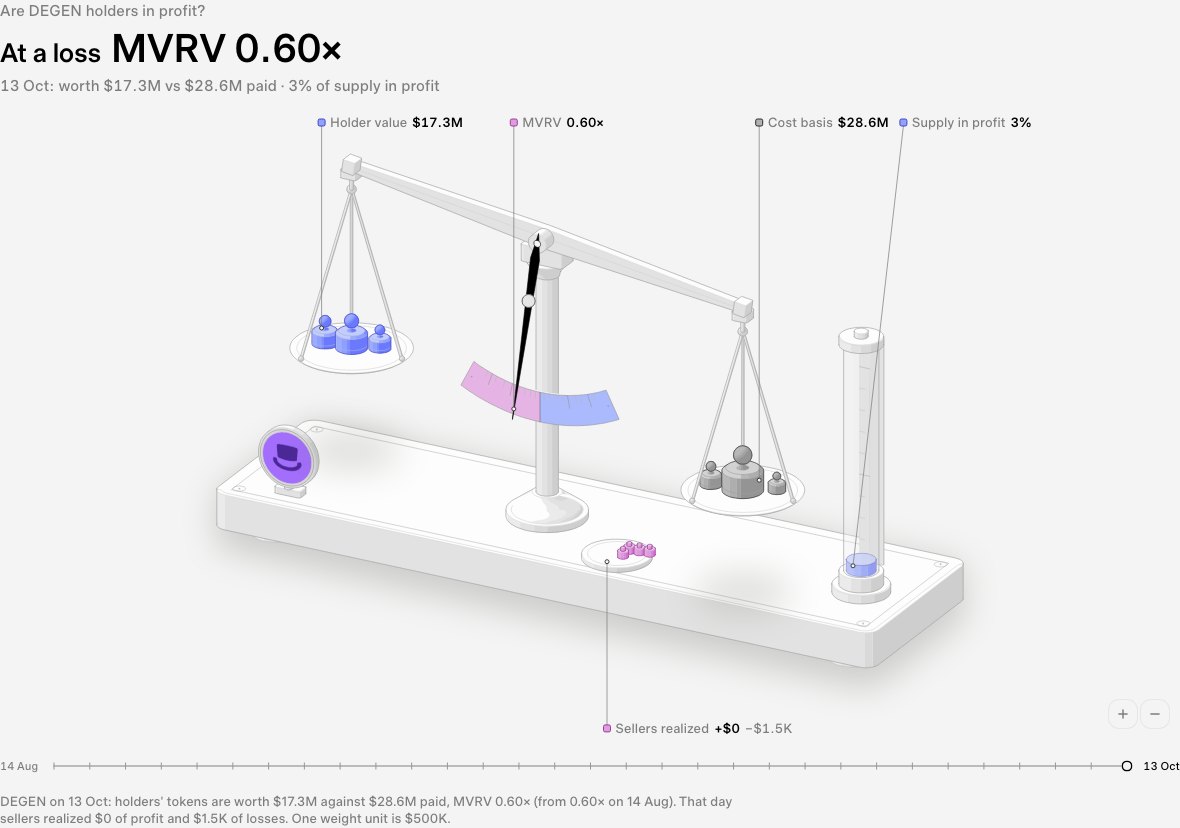
The cost-basis balance shows the same two numbers as weights on a balance: its pans hang below the knife edges, so the beam's tilt depends only on their ratio.
tan θ = k · (MVRV − 1) ÷ (MVRV + 1)
How to read it
- High
- Holder value far above cost basis: holders as a group sit on a large unrealised profit.
- Low
- Holder value far below cost basis: holders as a group sit on a large unrealised loss.
- Rising
- The gap widening upward: price is outrunning what holders paid.
- Falling
- The gap closing or turning negative: value is falling toward or under what holders paid.
Evidence in the data, never advice
Common pitfalls
- It is an aggregate. A holder base in profit overall can still have most wallets at a loss, if the early large holders are deep in profit.
- The average holder is an average too: a few large early wallets can be up a lot while most are down. Holder value counts tokens on exchanges, which the holder count leaves out, so the average leans high where exchanges hold much of it.
- Cost basis is not fixed. It is what current holders paid, so it moves whenever tokens change hands at a new price.
- The cost-basis panel can carry a partial row for the current UTC day whose figures still move; the signal rules read settled days only.
- It describes where holders stand today; it doesn't forecast a price.
See it on…
Where it stands out in the latest snapshot. Tokens under a $1M market cap are left out
Furthest above cost basis
Furthest below cost basis
Cards that show it
Drawn on DEGEN; open one on its page
Related
- Cost basis & profitRealized cap (cost basis)The total that current holders paid for the tokens they hold, in dollars: the holder base's aggregate cost basis.
- Cost basis & profitMVRVHolder value divided by cost basis. Above 1 the average holder is in profit; below 1, at a loss.
- Cost basis & profitSupply in profitThe share of held supply acquired below the day's price. The rest was acquired above it and sits at a loss.
- SignalsSignal family: price vs cost basisRules on price against what holders paid: MVRV under or over 1, its trend, crossings, touches of the cost line.
Every figure on this page comes from Blocktronics' stored, public reads. It describes what the data shows; it is not advice.