Smart money netflow
Net buying by the wallets Blocktronics flags as proven smart money, in dollars per day: accumulating above zero, distributing below.
Net per day. The flagged smart-money wallets' net flow in DEGEN, day by day: accumulating above zero, distributing below.
The real card
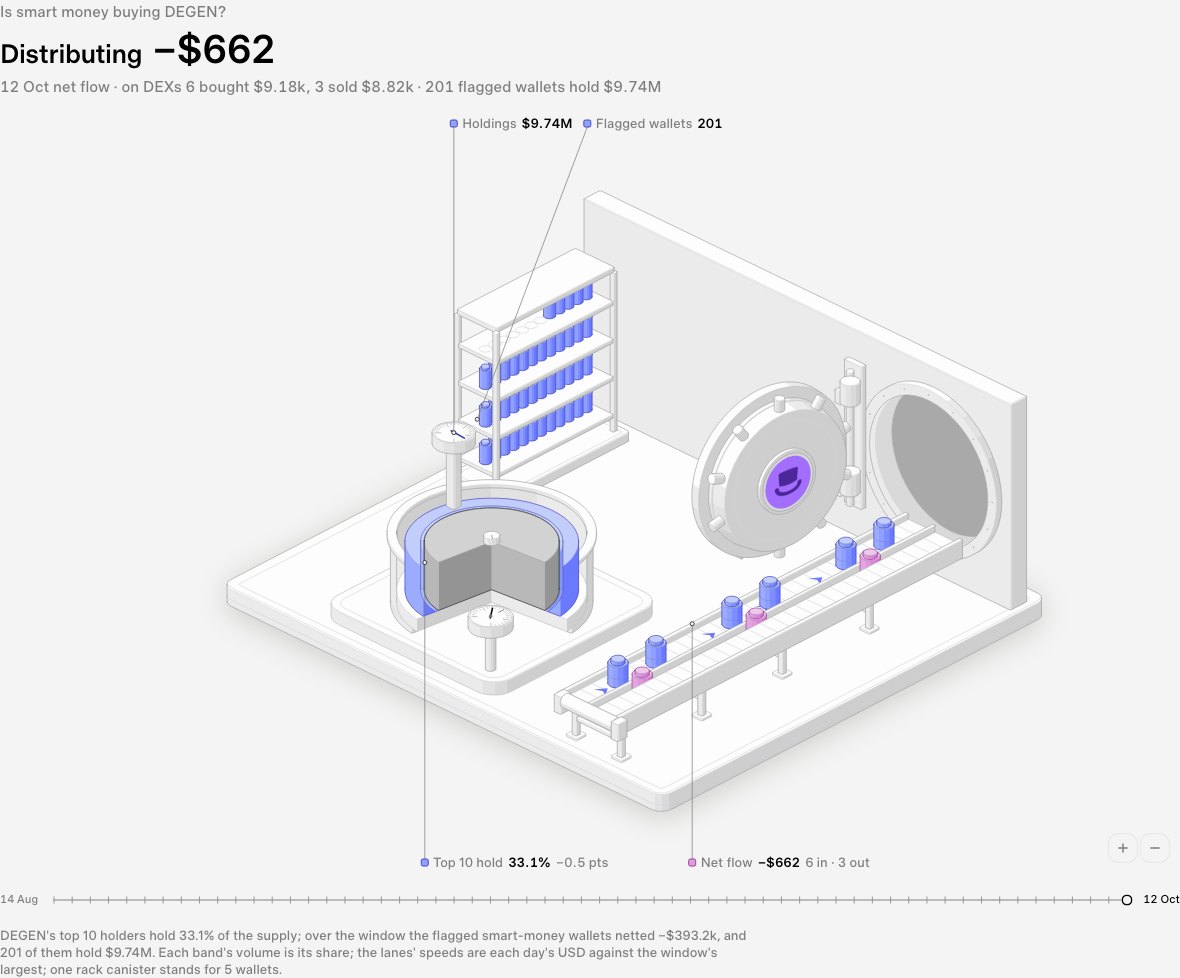
Smart money netflow, live on DEGEN. Switch to any cached token.
Smart money
Bought above the line in green, sold below in red; each chain its own shade
Every chain: 59 of 60 days stored (1 Sep to 29 Oct) · 59 covered · 59 priced · 59 with venue prices · 59 on the current computation
Put this card on a dashboard of your own, or get told when the figure moves
What it is
Smart money is a cohort of wallets the Blocktronics backend flags as proven: the signal rules describe them as wallets with a track record. This card follows what that cohort does on one token.
Each day's figure is the cohort's net flow in dollars: positive when the flagged wallets added to the token on net (accumulating), negative when they reduced it (distributing).
Smart money on Blocktronics is not every large wallet.
Size alone says nothing about skill, so a big account adding to a token doesn't make it smart money.
The cohort is wallets with a repeated track record.
How wallets are chosen stays private, so the cohort can't be copied or gamed. The public read carries the cohort's flows and holdings for each token, not the list of wallets.
What goes into it
- 1
The smart-money panel stores, per settled day, the cohort's net flow and its DEX purchases and sales with how many flagged wallets made them.
- 2
Daily bars run from zero, accumulating on one side and distributing on the other. Running adds the days up; a missing day stays a gap and adds nothing. The headline is the net over the stored days.
headline = Σ daily net flow over the window - 3
The snapshot keeps each token's net over the last 30 calendar days ending at the panel's own last day, which the market cards rank.
- 4
The accumulation rules set the month's net against what the cohort holds.
How to read it
- High
- The flagged wallets have been net buyers of the token over the window.
- Low
- The flagged wallets have been net sellers.
- Rising
- Accumulation building. A run of settled days in a row of net buying is the smart-money buying-streak rule.
- Falling
- Distribution building. Net selling over the most recent days after net buying over the weeks before is the turned-seller rule.
Evidence in the data, never advice
Common pitfalls
- A cohort can be small on one token: a single flagged wallet can make the month. The card's subtitle says how many flagged wallets hold it.
- A large net relative to the market can still be small relative to what the cohort holds; the rules check both.
- The cohort is chosen on its record, not on what it does next: the cards show what it did.
- The cohort is the backend's and is refined over time, so its membership can change and a long running total mixes slightly different sets of wallets.
- The net flow and the DEX purchases and sales are separate fields of the panel; the DEX figures don't always add up to the net.
See it on…
Where it stands out in the latest snapshot. Tokens under a $1M market cap are left out
Smart money accumulating most
Distributing most
Cards that show it
Drawn on DEGEN; open one on its page
Related
- Smart moneyFlagged wallets and their holdingsHow many flagged smart-money wallets hold the token, and what their holdings are worth in dollars.
- FlowsDEX netflowDollars bought minus dollars sold through the token's DEX pools, per day. Positive is net buying, negative net selling.
- SignalsSignal family: smart moneyRules on the flagged smart-money wallets: buying or selling streaks, a month of accumulation or distribution, and turns.
- FlowsToday, by hourThe current UTC day, hour by hour, up to the last read: net flow, buying and selling, for everyone or for smart money.
Every figure on this page comes from Blocktronics' stored, public reads. It describes what the data shows; it is not advice.