Grade pillar: economics
Holder economics: MVRV and the share of supply in profit, each against the fleet.
Every token. Economics pillar score for each of the 216 cached tokens that have one: one dot each.
The real card
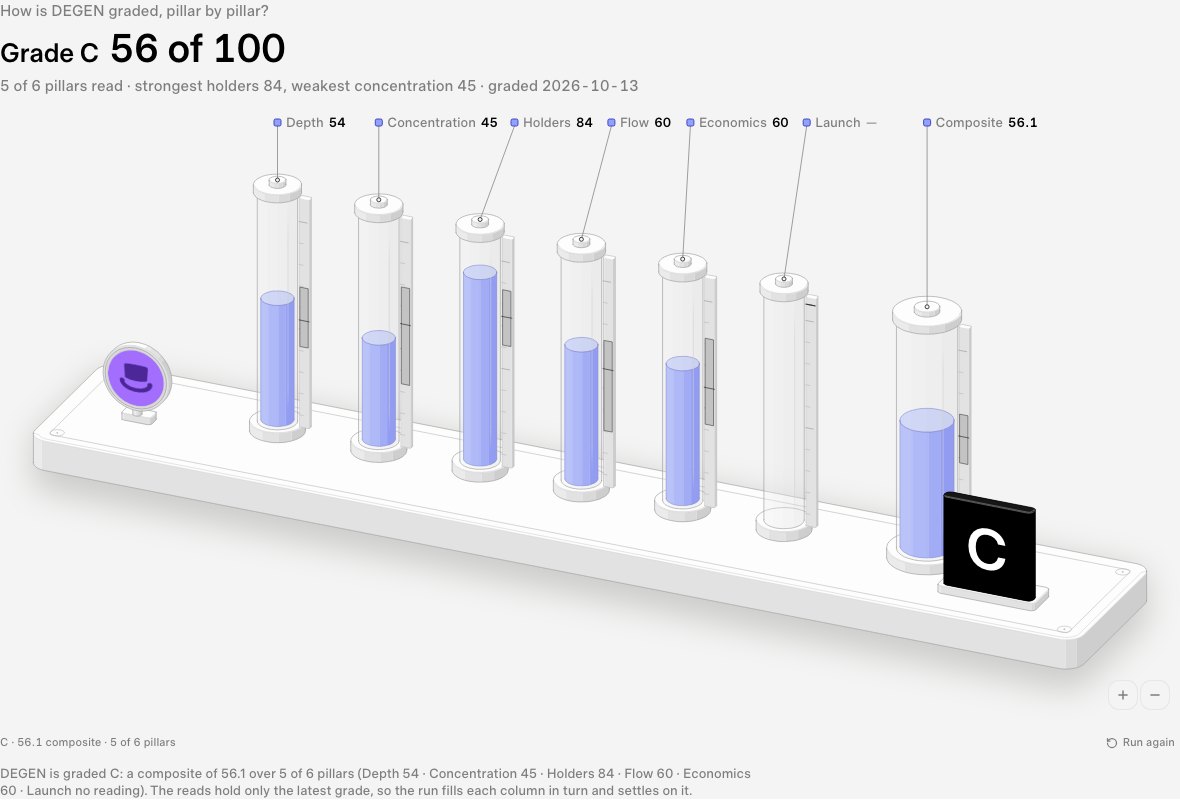
Blocktronics grade, live on DEGEN. Switch to any cached token.
Blocktronics grade
Put this card on a dashboard of your own, or get told when the figure moves
What it is
The economics pillar scores where holders stand against what they paid, relative to the rest of the fleet.
Its detail line gives the token's MVRV and supply in profit against the fleet's. Without enough cost-basis days it is absent.
What goes into it
- 1
The backend scores the pillar from 0 to 100, against the fleet, and records a one-line reading beside the score. A pillar it couldn't measure has no score and a reason instead: it is dropped, never scored zero.
- 2
The grade card places the score on a 0–100 track against the fleet: the median score across every cached token (a tick) and the middle half, the 25th to 75th percentile (a band).
How to read it
- High
- Holders stand better against their cost than the fleet's typical holders.
- Low
- Holders stand worse against their cost than the fleet's typical holders.
- Rising
- Holder economics improved at the last grading.
- Falling
- Holder economics worsened at the last grading.
Evidence in the data, never advice
Common pitfalls
- 50 is the fleet's typical token, not a pass mark: a 45 is a little below typical, not a fail.
- The detail line is the backend's evidence for the score; the card shows it in the data table and the hover.
- Scores are as of the last grading (the read holds no history of them).
- It is relative to the fleet: when most tokens trade under their cost, a token at break-even scores well.
See it on…
Where it stands out in the latest snapshot. Tokens under a $1M market cap are left out
Highest on this pillar
Lowest on this pillar
Cards that show it
Drawn on DEGEN; open one on its page
Related
- The gradeThe Blocktronics gradeAn A to E badge for structural fragility: how safely a position can be held and exited. Not a view on where price is going.
- Cost basis & profitMVRVHolder value divided by cost basis. Above 1 the average holder is in profit; below 1, at a loss.
- Cost basis & profitSupply in profitThe share of held supply acquired below the day's price. The rest was acquired above it and sits at a loss.
Every figure on this page comes from Blocktronics' stored, public reads. It describes what the data shows; it is not advice.